
Corporate Governance
Basic Approach
To retain the trust of all of our stakeholders, KOITO recognizes the importance of ethical standards and has identified enhancing "corporate governance" as one of our materialities. We are striving to establish a sound management structure.
Organization for Corporate Governance
1. Board of Directors
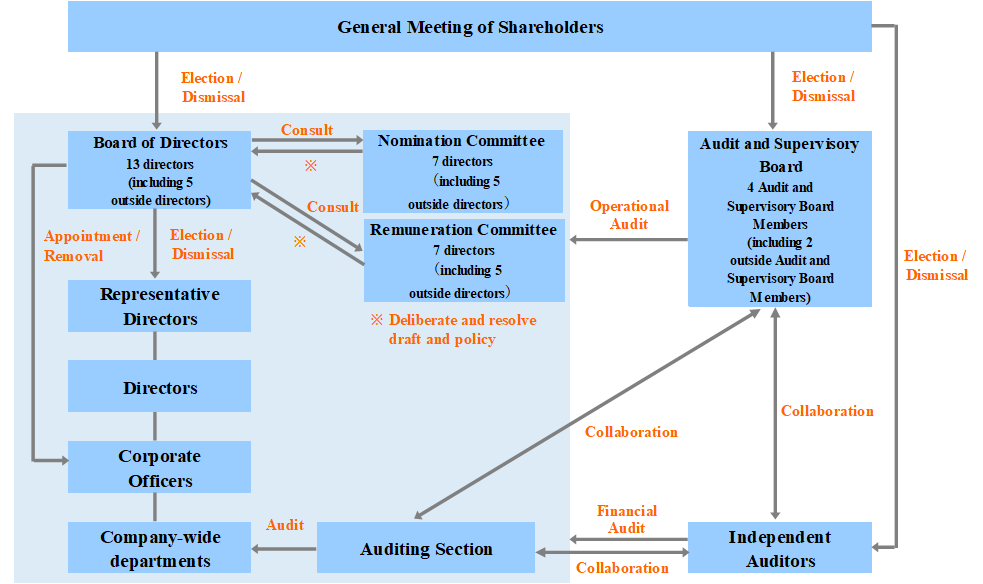
The Board of Directors is chaired by the President, and comprises 13 Directors (including 5 Outside Directors).In principle, the Board of Directors meets once per month.
All directors attended all Board of Directors meetings in FY2025.
The Company's Board of Directors discusses, reports, and makes decisions on matters stipulated in the Board of Directors' Regulations, including those stipulated by laws, regulations, and the Articles of Incorporation, and supervises the execution of director's business execution. In addition, all Audit and Supervisory Board Members attend the Board of Directors to monitor Director's business operations.
The Managing Committee comprises full-time Directors and a Corporate Officer as a body to aid the Board of Directors. The committee meets, in principle, 3 times per month, determines business execution, reports on progress and follows up on business execution.
The governance is being reinforced, such as that a new activity requires the approval of the Managing Committee and then the Board of Directors before starting.
2. Audit and Supervisory Board
The Audit and Supervisory Board comprises 4 Audit and Supervisory Board Members (2 standing Audit and Supervisory Board Members and 2 outside Audit and Supervisory Board Members) and the meetings are held regularly.
Other than the Board of Directors, the standing Audit and Supervisory Board Members attend the Managing Committee and other important meetings or committees to express their opinions as needed. This structure enables Audit and Supervisory Board Members to constantly monitor the Director's business executions. The Company also strives to improve its auditing functions through close collaboration between Audit and Supervisory Board Members, Internal Audit Department and independent auditors, by allowing them to exchange information and opinions as needed, and to hold regular meetings.
3. Status of Audits
Based on the annual audit plans, KOITO's Internal Audit Department, an independent organization, conducts audits of the operations of internal control over financial reporting, as well as audits of the legality and appropriateness of operations against company-wide departments and KOITO's subsidiaries. The departments and subsidiaries implement the necessary improvements to improve internal control. In addition, the Internal Audit Department ensures the effectiveness of internal audits by ensuring reporting procedures to directors and corporate auditors, and exchanges information with corporate auditors and accounting auditors regarding the status of audits, thereby promoting mutual cooperation.
At the first meeting of the Audit and Supervisory Board after the annual general meeting of shareholders each year, the Audit and Supervisory Board discusses and establishes the annual activity policy, the responsibilities of each corporate auditor, and an annual audit plan. The audit is conducted based on the plan. Other than attending and expressing opinions at the Board of Directors, Audit and Supervisory Board Members audit the execution of Directors' duties, legality and appropriateness of KOITO's decision-making based on their knowledge and experience in each specialized field. In addition to Audit and Supervisory Board Members' on-site audits and interviews with administrative divisions, Audit and Supervisory Board Members attend the audits performed by the independent auditors and the Internal Audit Department. Audit and Supervisory Board Members strive to improve the effectiveness of audit by maintaining collaboration with relevant parties, including outside Directors by exchanging information as needed. Outside Audit and Supervisory Board Members contribute to KOITO's management strategies planning and the enhancement of corporate governance. This is achieved through inquiries and comments made at liaison meetings with the Board of Directors, Audit and Supervisory Board, independent auditors and outside Directors, based on their knowledge in each specialized field as well as information from Audit and Supervisory Board Members.
In addition, KOITO has established an Audit and Supervisory Board Member's Office so that independent staffs can assist Audit and Supervisory Board Members with their duties.
In FY2025, a total of 9 Audit and Supervisory Board were held, and all Audit and Supervisory Board Members, including outside Audit and Supervisory Board Members, have attended to all meetings. The matters discussed in the Audit and Supervisory Board are evaluation, reappointment, and remuneration agreement with the independent auditors, legality or appropriateness of matters discussed in the Ordinary General Meeting of Shareholders, the deliberation and preparation of Audit Report, and preparation of Audit Plan.
Major items reported include the status of accounting audits, the selection of major audit considerations and the status of audits, monthly audit results by full-time corporate auditors, and the details of consultations and reports to the Corporate Ethics Consulting Desks.
KOITO's accounting audit has been Deloitte Touche Tohmatsu LLC since June 2026. The accounting audit is performed by certified public accountants, Takuma Ueki and Masahiro Fujimori. Furthermore, certified public accountants and persons who passed the certified public accountant examination who belong to Deloitte Touche Tohmatsu LLC assist the accounting audit.
KOITO establishes a policy on selecting audit corporations; appropriate size as an audit corporation, the expertise and independence required to accounting auditors, and a system to ensure the appropriateness of accounting audits.
Election Policy for Directors and Audit and Supervisory Board Members
KOITO's policy is to nominate Director candidates who respond to the delegation of management by shareholders, possesses a wealth of experience and insight into management, and who can fulfill directors' duties and responsibilities.
Based on this policy, the Nomination Committee shall be deliberate and resolve a draft of Director candidates, and then the Director candidates are determined by the Board of Directors.
To ensure objectivity and transparency of the nominations of the Director candidates, the Nomination Committee, and advisory body to the Board of Directors, consist of 2 Inside Directors and 5 Independent Outside Directors.
With regard to Audit and Supervisory Board Members, the Company's policy is to select candidates who have good personalities, insight, and high ethical standards that enable them to properly, fairly, and efficiently execute audits of the execution of director's duties.
Based on this policy, Audit and Supervisory Board Member candidates are elected by the Board of Directors with the consent of the Audit and Supervisory Board.
In the event of a situation that deviates from the above-mentioned policy, the Board of Directors shall decide on dismissal after a resolution at a General Meeting of Shareholders.
Corporate Officer Regulations stipulate that the appointment and dismissal of corporate officers shall be subject to a resolution of the Board of Directors.
Skill Matrix of Boad of Directors
Under the corporate message "Lighting for Your Safety," we have established the KOITO VISION--"Lighting the Way for Our Sustainable Future"--to ensure that we remain committed to safety, security, and contributing to society. We have also set management goals for fiscal 2030 to guide our efforts toward achieving this vision.
In pursuit of these goals, the Company's Board of Directors is working to enhance its effectiveness by implementing improvement initiatives such as strengthening its function as the highest decision-making body for management and streamlining the process of management decision-making.
The reasons for selecting skills required of Directors are as follows:
Required Areas of Expertise and Specialization of Directors toward achieving KOITO VISION (Skill Matrix)
| Corporate Management | To capitalize on the experience of Directors and other executives in corporate management and make prompt management decisions in a rapidly changing environment |
|---|---|
| Sales, Purchasing | To improve the KOITO Group's profitability by implementing sales strategies that anticipate market needs and optimizing procurement costs |
| Engineering, R&D | By promptly and accurately identifying trends among clients and in domestic and international technology, to pursue strategic technology and product development that anticipates customer needs, and to expand market share and develop new markets |
| Production, Quality Management, Safe & Environment | To optimize production systems and promote innovation in manufacturing; to strengthen quality assurance structures that meet regulatory requirements, adapt to environmental changes, and satisfy customer quality demands; and to establish a health and safety management system |
| Overseas Segment | To formulate international strategies that address the globalization and borderless nature of the global market, and to plan, promote, and control our overseas segment |
| Finance, Accounting, Capital Policy | To ensure accurate financial reporting, maintain financial soundness, and make effective use of the Company's capital, including optimizing the balance sheet by leveraging financial expertise |
| Legal, Risk Management | Based on legal affairs and risk management expertise, to enhance governance and compliance so that the KOITO Group can build, maintain, and strengthen relationships of trust with all stakeholders |
Main Areas of Expertise and Specialization of Directors (Skill Matrix)
| Name |
Corporate Management |
Sales, Purchasing |
Engineering, R&D |
Production, Quality Management, Safe & Environment |
Overseas Segment |
Finance, Accounting, Capital Policy |
Legal, Risk Management |
|
|---|---|---|---|---|---|---|---|---|
| 1 |
Masahiro Otake |
● | ● | ● | ● | ● | ||
| 2 |
Michiaki Kato |
● | ● | ● | ● | |||
| 3 |
Masami Uchiyama |
● | ● | ● | ● | ● | ||
| 4 |
Hideharu Konagaya |
● | ● | ● | ● | ● | ||
| 5 |
Jun Toyota |
● | ● |
● |
● | |||
| 6 |
Katsuyuki Kusakawa |
● | ● | ● | ● | ● | ||
| 7 |
Eisuke Shibata |
● | ● | ● | ● | |||
| 8 |
Takahito Otake |
● | ● | ● | ● | |||
| 9 |
Haruya Uehara |
● | ● | ● | ● | |||
|
10 |
Kingo Sakurai |
● | ● | |||||
| 11 |
Chika Igarashi |
● | ● | |||||
| 12 |
Risa Tanaka |
● | ● | ● | ||||
| 13 |
Yoshimasa Kawata |
● | ● |
(Note: Above chart does not represent every skill of each directors.
Outside Directors and Audit and Supervisory Board Members
KOITO's policy is to appoint an outside Director with effective independence in accordance with the independence requirements set forth in the Corporation Act and the independence standards set forth in the Independent Directors/Auditors System of the Tokyo Stock Exchange.
As for Outside Director and Audit and Supervisory Board Member candidates, the Board of Directors appoints a person with extensive knowledge and experience in corporate management or with expertise in legal and financial matters. Outside Directors and Audit and Supervisory Board Member are also elected at the General Meeting of shareholders.
The reasons for the election of Director and Audit and Supervisory Board Member candidates are described in the reference document of the Notice of the General Meeting of Shareholders. In the event of dismissal, the reason for such dismissal shall be stated in the reference document of the Notice of the General Meeting of Shareholders.
The election and dismissal of each corporate officer has been decided by the Board of Directors.
Director and Audit and Supervisory Board Member Diversity Policy
Each Director has thorough knowledge of the management of each business. Including Outside Directors, Directors are structured in a way that balances expertise, experience, and capabilities. When selecting Directors, the Nomination Committee deliberates and resolves a draft of Director candidates, and then the Director candidates are determined by the Board of Directors.
As for the election of Audit and Supervisory Board Members, KOITO expects candidates to have a good personality and a strong sense of ethics to accurately, fairly, and efficiently execute the audits of the execution of Director duties. In particular, outside Audit and Supervisory Board Members are selected from among experts with expertise in legal and financial matters.
Director Effectiveness Evaluation
KOITO conducts annual surveys targeting all directors and Audit and Supervisory Board members to evaluate the effectiveness of the Board of Directors. The Board of Directors evaluates itself based on the survey findings.
The following is the outline of the results of this analysis and evaluation of effectiveness of the Board of Directors in FY2025.
- In principle, the Board of Directors meets once a month to discuss important issues in a timely and appropriate manner in accordance with the Board of Directors' regulations.
- Prior to the beginning of the fiscal year, the annual meeting schedules are announced to Directors and Audit and Supervisory Board Members, including its outside members, making it easier for them to attend the meetings. To facilitate discussion on management issues of the Board of Directors, the matters to be deliberated and reported at the meeting and the content of the materials are discussed in advance.
- In addition to Directors, who have experience in the various business divisions such as management, sales, technical, production and others, the Board of Directors also receives advice and proposals from outside Directors with extensive knowledge and experience of corporate management, or with expertise in legal and financial matters. The Board of Directors ensures sufficient time and discusses management issues from a variety of perspectives.
In the future, the Company will further strengthen its functions as the highest decision-making organization for management and improve the speed of management decision-making in order to enhance the effectiveness of the Board of Directors.
Training for Directors and Corporate Officers
KOITO provides training for Directors and Corporate Officers to promote knowledge acquisition and an understanding of their roles and responsibilities as necessary.
Remuneration of Directors
It was approved at the 125th Ordinary General Meeting of Shareholders held on June 27, 2025, that the amount of remuneration, etc. for the Company's Directors shall be no more than ¥1.5 billion (of which, the annual amount of remuneration for Outside Directors is to be no more than ¥0.1 billion) a year. At the same shareholders meeting, that, apart from the amount of remuneration, etc., for Directors described above, the amount of remuneration, etc., related to restricted stocks for Directors shall be no more than ¥0.5 billion a year.
The Directors' remuneration system consists of fixed monthly remuneration, and stock-based remuneration. Based on the Company's internal standards on Director's remuneration, the Company comprehensively determines the amount of remuneration by taking several factors into account: corporate performance, shareholder dividend level, remuneration amount of other companies, the amount of employees' salaries, as well as the Director's management capabilities, achievements, and their contributions.
The fixed remuneration amount is calculated by setting a basic amount in based on the size of the role of each Director and their position, then setting the upper and lower limit amount for each position, the status difference by position, and the difference by the number of years in the position.
Performance-linked remuneration is evaluated and decided based on the belief that it is important to comprehensively consider the goals and achievements of each fiscal year's performance (net sales, profits, etc.) and each Director's contribution.
Stock-based remuneration is determined based on the amounts of fixed remuneration and performance-linked remuneration, using TSR (Total Shareholder Return: a comparison of the Company's actual results with a pre-established comparison group regarding total shareholder return) and ESG (the degree of achievement of the Company's environmental, social and governance goals) for each fiscal year as metrics.
The Board of Directors consults with the Remuneration Committee regarding the policy to determine the remuneration and the policy, etc. to determine the renumeration of each Director.
The remuneration of each Director is determined at the Board of Directors.
To ensure objectivity and transparency of the Director's remuneration determination procedure and others, the Remuneration Committee, an advisory body to the Board of Directors, consists of 2 Inside Directors and 5 Independent Outside Directors.
For Outside Directors, only fixed remuneration is paid, and no performance-linked remuneration is paid.
Breakdown of FY2025
|
The number of eligible members |
Total amount of remuneration, etc. by type (million yen)
|
Total amount of |
|||
|---|---|---|---|---|---|
|
Fixed remuneration |
Performance-linked remuneration |
Non-monetary |
|||
| Director | 14 |
624 |
243 | 111 | 978 |
|
Audit and Supervisory Board Members |
4 | 107 | - | - | 107 |
| Total | 18 | 731 | 243 | 111 | 1,085 |
- The above table includes one resigned Director on February 28, 2026
- Aggregate remuneration for the Outside Directors and Outside Audit and Supervisory Board Members, a total of seven individuals, was ¥90 million. (Fixed remuneration only.)
- Besides the above, one Outside Audit and Supervisory Board Member have received executives' remuneration of ¥0 million from Koito Insurance Services Co., Ltd., a subsidiary of the Company.
- For Performance-linked remuneration, recurring profit is used as an indicator since it reflects the overall results of the Company's management activities, and the remuneration is calculated giving consideration to the year-on-year change in this indicator. The amounts listed for recurring profit for the fiscal year under review and for the previous fiscal year are the amounts presented in the non-consolidated statements of income.
- The non-monetary remuneration consists of the Company's shares,
Basic Policy of Internal Control System
The Basic Policy of the Internal Control System is set as follows to improve and strengthen internal control.
- System ensuring that Directors and employees execute their business duties in compliance with laws and regulations and the Company's Articles of Incorporation
The Compliance Committee, Compliance Department, Internal Audit Department, whistle-blower internal reporting system, and other organizations and systems, as well as the Code of Corporate Ethics and other relevant regulations, will be developed and enhanced based on the KOITO Group Corporate Behavior Charter.
At the same time, KOITO's Directors, Corporate Officers and employees will receive education familiarizing them with organizations, systems, and regulations. - System for the preservation and administration of information on Directors executing their business duties
Regulations will be developed and enhanced to appropriately preserve and administer minutes to the General Meeting of Shareholders, the Board of Directors, Managing Committee, and other information on Directors executing their business duties. - Regulations and other systems for managing the risk of loss
Risk Management Regulations and other regulations and systems for managing risk will be developed to avoid and eliminate material risks that could threaten the Company's survival, and minimize the impact when they arise. At the same time, KOITO's Directors, corporate officers, and employees will receive education and training on risk management. - System for ensuring the efficient execution of business duties by Directors
The Board of Directors and Managing Committee meetings will be held regularly. Meanwhile, Board of Directors Regulations, Managing Committee Regulations and other regulations pertaining to the execution of business duties by Directors, as well as the corporate officer system and other organizations and systems, will be developed and enhanced to ensure the efficient execution of business duties by Directors.
At the same time, business duties will be executed according to specific plans the divisions develop each year based on the president's policy. - System for ensuring appropriate business execution by the corporate group comprising KOITO and its subsidiaries
KOITO and its Group companies will subscribe together to the KOITO Group Corporate Behavior Charter and develop a system for ensuring and administering the appropriate execution of business duties.
ⅰ. Based on the Affiliates Management Regulations etc., KOITO will specify matters to be reported by affiliates, enhance the Group's reporting system, and ensure that Group companies file periodic reports
with KOITO.
ⅱ. Based on the Affiliates Management Regulations etc., KOITO will monitor the risks to the Group as a whole in a comprehensive and centralized manner. Whenever it finds insufficiency in a Group company's action, KOITO will give guidance or implement other collective measures.
ⅲ. KOITO will ensure that Group companies prepare and keep their regulations, organizations, and systems to ensure periodic Board of Directors' and Directors' fulfillment of their duties. For important affiliates, Directors of KOITO may concurrently hold offices of Directors of such affiliates.
ⅳ. Based on the KOITO Group Corporate Behavior Charter, KOITO will ensure that Group companies achieve compliance (with laws and ordinances) and KOITO's Administrative and Internal Audit Departments audit affiliates' operations and accounting. Further, based on the Affiliates Management Regulations KOITO will specify matters subject to KOITO's approval, and ensure that Group companies first obtain KOITO's approval before carrying out such matters. - Matters pertaining to the status of certain employees, independence from Directors, and the viability of instruction in the event corporate auditors request such employees to assist in the execution of their duties
An Audit and Supervisory Board Member's Office will be established to help the Audit and Supervisory Board Members execute their duties under the instructions and orders of the Audit and Supervisory Board Members and the Audit and Supervisory Board. Moreover, assignment of personnel to the Audit and Supervisory Board Members' office shall be decided upon approval by the Audit and Supervisory Board to ensure independence from Directors. - System for Directors and employees of KOITO and its subsidiaries to report to Audit and Supervisory Board Members and for preventing unfair treatment of the Directors and employees for reporting to the Audit and Supervisory Board Members
Directors, corporate officers, and employees of KOITO and its Group companies shall report to the Audit and Supervisory Board Members when they learn of matters of material impact on the Company; serious violations of laws, regulations, and the Company's Articles of Incorporation; and other issues of compliance.
Moreover, each Audit and Supervisory Board Members shall exercise their own discretion in reporting the findings from such reports to the Audit and Supervisory Board.
Meanwhile, the Company's organization and systems will be developed and enhanced to rigorously prevent the unfair treatment of Directors, corporate officers, and employees for reporting to the Audit and Supervisory Board Members. - Policy on expenses arising from the Audit and Supervisory Board Members of KOITO executing their duties and system for enabling the Audit and Supervisory Board Members to conduct effective audits
The Company shall pay all necessary expenses involved in the Audit and Supervisory Board Member executing their duties.
The Audit and Supervisory Board Member shall monitor and audit the execution of business duties at the Company by means that include attending the Board of Directors, Managing Committee, Compliance Committees, and other relevant conferences and committees and examining important documents.
The Audit and Supervisory Board Member shall exchange opinions periodically, or as need be with Directors, corporate officers, independent auditors, and the Internal Audit Department, among others.